When people think about moving to Japan, Tokyo, Osaka, and Kyoto usually come to mind first. But many residents, both Japanese and international, have discovered a quieter, sunnier alternative in western Japan: Okayama.
Okayama Prefecture has a population of about 1.8 million and sits on the Seto Inland Sea, between Osaka and Hiroshima. It offers city convenience, countryside calm, and easy access to the rest of Japan.
In this guide, a local real estate agency introduces eight reasons why Okayama is worth considering as a place to live. All information is current as of November 2026.
1. The Most Dry Days in Japan: “The Land of Sunshine”
Okayama is known as Hare no Kuni, or “the Land of Sunshine.” The nickname is backed by data: based on the Japan Meteorological Agency’s 30-year averages (1991–2020), Okayama has the most days per year with less than 1 mm of precipitation of any prefectural capital in Japan.
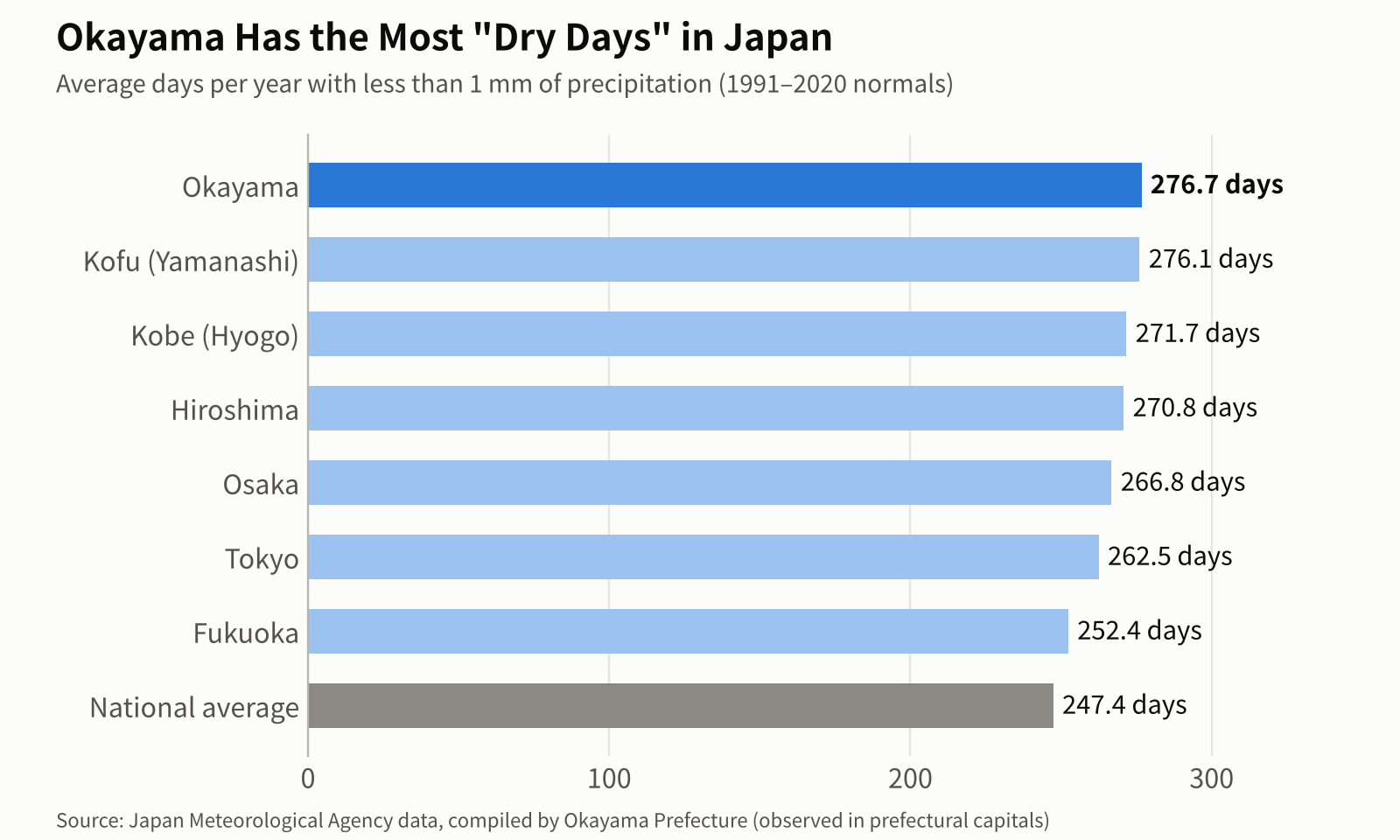
| City | Days with less than 1 mm of precipitation (per year) |
|---|---|
| Okayama | 276.7 (No. 1 in Japan) |
| Kofu (Yamanashi) | 276.1 |
| Kobe (Hyogo) | 271.7 |
| Hiroshima | 270.8 |
| Osaka | 266.8 |
| Tokyo | 262.5 |
| Fukuoka | 252.4 |
| National average | 247.4 |
The mountains of the Chugoku region to the north and Shikoku to the south shelter the area, which is one reason the climate is relatively mild. That said, Okayama is not free from natural disasters. Parts of the prefecture were severely flooded during the heavy rains of July 2018, so it is important to check hazard maps when choosing where to live.
2. A Transport Hub for Western Japan
Okayama Station is one of the key junctions in western Japan. The Sanyo Shinkansen (bullet train) stops here, and limited express trains run to Shikoku and the Sea of Japan coast.
- Shinkansen: direct trains to Osaka, Kyoto, Hiroshima, Fukuoka, and Tokyo. Osaka and Hiroshima are both within easy day-trip range.
- Shikoku: the Seto-Ohashi Line crosses the Great Seto Bridge to Kagawa Prefecture.
- Okayama Airport (Okayama Momotaro Airport): domestic flights to Tokyo (Haneda), Sapporo, and Okinawa, plus international flights to cities such as Seoul and Taipei.
Living in Okayama means you can enjoy a calmer daily life while still reaching Japan’s major cities quickly.
3. City Life Without the Crowds
Okayama City, the prefectural capital, has a population of about 707,000, and neighboring Kurashiki is the prefecture’s second-largest city. Department stores, shopping malls, hospitals, and universities are all close at hand, yet daily life is far less crowded than in Tokyo or Osaka.
Okayama City has a tram network, and many residents get around by bicycle in the flat city center. Outside the urban core, however, a car makes daily life much easier.
4. Famous Fruit and Seafood
Okayama is often called the “Fruit Kingdom” of Japan. It is especially famous for:
- White peaches: soft, juicy, and highly prized as gifts in Japan
- Grapes: including Muscat of Alexandria and the large, dark Pione variety
- Seafood from the Seto Inland Sea: such as oysters from Hinase, often enjoyed in kaki-oko (oyster okonomiyaki)
Farmers’ markets and roadside stations (michi-no-eki) sell fresh local produce at reasonable prices.
5. History and Culture
- Korakuen Garden: one of the Three Great Gardens of Japan, located across the river from Okayama Castle
- Okayama Castle: nicknamed “Crow Castle” for its black exterior
- Kurashiki Bikan Historical Quarter: a canal district lined with white-walled storehouses, home to the Ohara Museum of Art
- Bizen ware: unglazed pottery from one of Japan’s oldest pottery traditions
- The legend of Momotaro: Okayama is closely associated with the folk tale of Momotaro, the “Peach Boy”
6. Gateway to the Art Islands of the Seto Inland Sea
Ferries from Uno Port in Tamano, Okayama, connect to Naoshima and other islands in the Seto Inland Sea, which are famous for contemporary art museums and outdoor installations. The Setouchi Triennale, an international art festival held every three years, draws visitors from around the world.
Living in Okayama makes it easy to visit these islands on a day trip, whenever you like, rather than only once on a vacation.
7. Denim, Craftsmanship, and Local Industry
The Kojima area of Kurashiki is widely known as a home of Japanese denim, with jeans workshops and a “Jeans Street.” Okayama also has a strong manufacturing base, including the Mizushima industrial area in Kurashiki, which supports jobs across the region.
8. A Growing International Community and Support for Foreign Residents
As of the end of 2025, 41,840 foreign residents lived in Okayama Prefecture, the highest number on record. The community is diverse, with residents from Vietnam, China, Indonesia, South Korea, the Philippines, and many other countries.
Multilingual support is available for daily life:
- Okayama Prefecture Foreign Residents Consultation Center: located in the Okayama International Center, it offers advice on work, marriage, children’s education, and other everyday issues in multiple languages.
- Okayama City General Consultation Counter for Foreign Residents: located on the first floor of Okayama City Hall, it offers free consultations on daily life and city procedures. Staff speak English, Chinese, Korean, and Vietnamese, and video interpretation is available in 16 languages.
Things to Keep in Mind
- A car is often necessary outside central Okayama City and Kurashiki.
- Summers are hot and humid, as in much of Japan.
- English is less widely spoken than in Tokyo, so basic Japanese will make daily life much easier.
- Natural disaster risk: check flood and landslide hazard maps before choosing a home.
Finding a Home in Okayama
Housing in Okayama ranges from apartments in the city center to traditional houses in the countryside. Okayama also has many vacant houses, known as akiya, which some people buy and renovate. For details on buying a vacant house, including costs, the 2026 rules for foreign buyers, and the risks to check, see our guide to buying an akiya in Okayama.
Frequently Asked Questions
Q. Is Okayama a good place for foreigners to live?
A. Many foreign residents live in Okayama, and the number reached a record high at the end of 2025. Multilingual consultation services are available at both the prefectural and city levels. However, English is not widely spoken in daily life, so learning some Japanese is recommended.
Q. How far is Okayama from Osaka and Tokyo?
A. Okayama is on the Sanyo Shinkansen line, with direct trains to both Osaka and Tokyo. Osaka is close enough for a day trip, and Tokyo can be reached by Shinkansen or by flying from Okayama Airport to Haneda.
Q. Why is Okayama called the “Land of Sunshine”?
A. Based on the Japan Meteorological Agency’s 30-year averages, Okayama has the most days per year with less than 1 mm of precipitation of any prefectural capital in Japan: 276.7 days, compared with a national average of 247.4.
Q. Do I need a car in Okayama?
A. In central Okayama City and Kurashiki, you can get by with trains, trams, buses, and a bicycle. In suburban and rural areas, a car is usually necessary.
Summary
- Okayama has the most dry days of any prefectural capital in Japan, earning it the name “the Land of Sunshine.”
- The Shinkansen, a junction for lines to Shikoku, and an airport make it a transport hub for western Japan.
- It offers city convenience without big-city crowds, plus famous fruit, history, and easy access to the art islands.
- Foreign residents reached a record 41,840 at the end of 2025, and multilingual support is available.
- Consider the need for a car, the hot summers, and natural disaster risks when choosing where to live.
Okayama offers a balanced lifestyle that combines sunshine, convenience, and a slower pace of life. If you are considering a move to Japan, it is well worth a closer look.
References
- Okayama Prefecture: Days with less than 1 mm of precipitation (Japanese)
- Okayama Prefecture: 2025 Census population results (Japanese)
- Okayama City: 2025 Census population results (Japanese)
- Okayama Prefecture: Foreign residents in Okayama, December 2025 (Japanese)
- Okayama Prefecture: Foreign Residents Consultation Center (Japanese)
- Okayama City: General Consultation Counter for Foreign Residents (Japanese/English)
- Okayama Prefecture: Okayama Momotaro Airport news (Japanese)
This article is based on information as of November 2026. Services, routes, and figures may change.
新着記事をメールでお届けします
不動産の売却・購入・投資に役立つ記事を公開したときに、メールでお知らせします。登録は無料で、いつでも配信を停止できます。