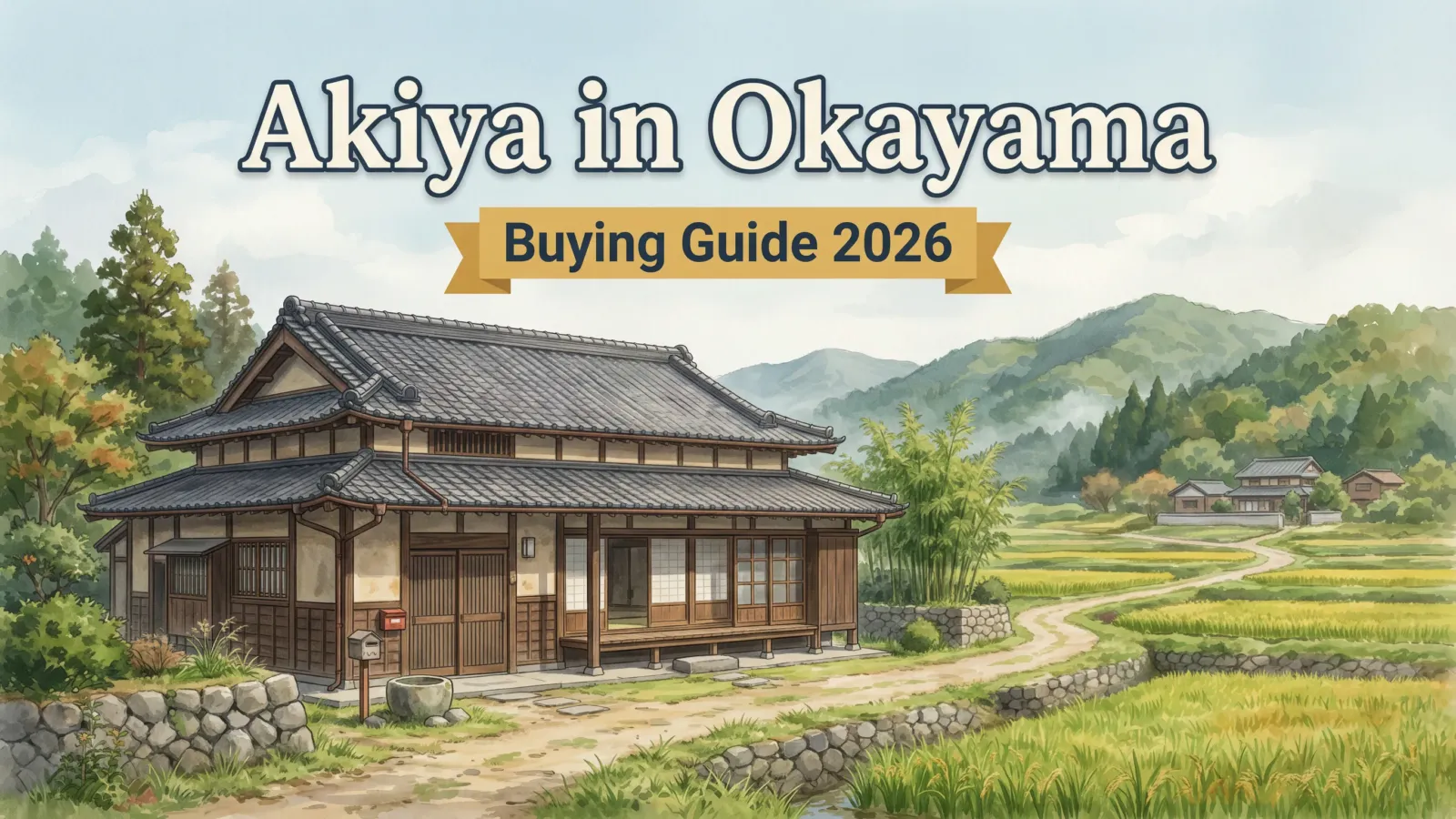
Japan’s inexpensive vacant houses, known as akiya, have drawn attention from around the world. Okayama Prefecture in western Japan is one place to find them. It is well connected, enjoys a mild climate, and has more than 150,000 vacant homes.
However, a low price does not always mean a good deal. Many akiya need major repairs, some cannot be rebuilt, and buying property in Japan comes with its own rules, especially if you live overseas.
This guide was written by a local real estate agency in Okayama. It explains where to find akiya, what they really cost, the 2026 rules for foreign buyers, and what to check before you buy. All information is current as of November 2026.
Why Buy an Akiya in Okayama?
A large supply of vacant homes
According to Japan’s 2023 Housing and Land Survey, Okayama Prefecture has 157,200 vacant homes. Its vacancy rate of 16.5% is above the national average of 13.8% and has been rising for decades.
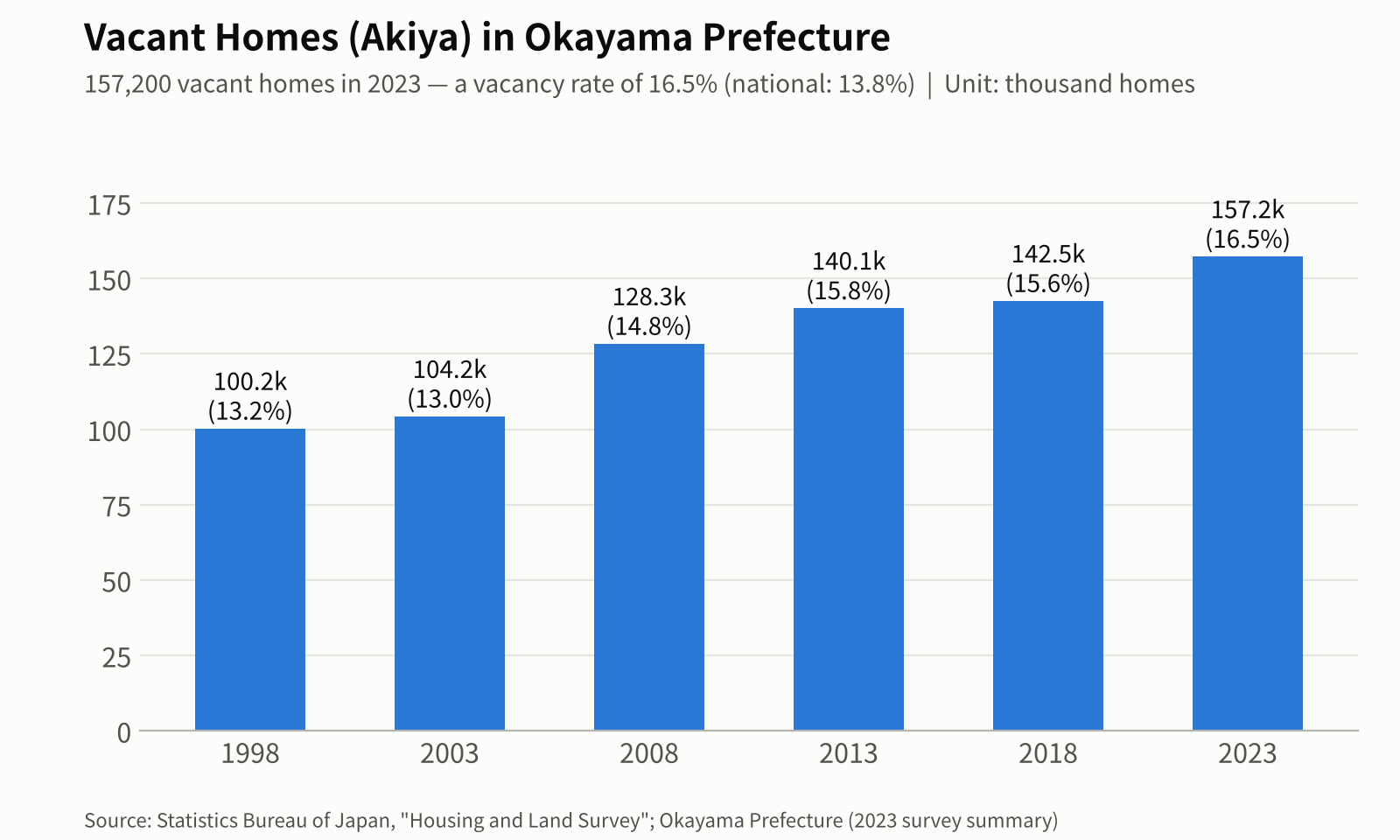
| Year | Vacant homes | Vacancy rate |
|---|---|---|
| 1998 | 100,200 | 13.2% |
| 2003 | 104,200 | 13.0% |
| 2008 | 128,300 | 14.8% |
| 2013 | 140,100 | 15.8% |
| 2018 | 142,500 | 15.6% |
| 2023 | 157,200 | 16.5% |
In Okayama City, the vacancy rate is about 14.5%, the fourth highest among Japan’s 20 designated major cities. According to the city, more than 80% of these vacant homes are still livable.
Easy access and a mild climate
Okayama Station is on the Sanyo Shinkansen (bullet train) line, with direct trains to Osaka, Kyoto, Hiroshima, and Tokyo. Okayama Airport serves domestic routes and some international flights. The prefecture is known as Hare no Kuni, or “the Land of Sunshine,” because of its many clear days.
Okayama is also a gateway to the art islands of the Seto Inland Sea, such as Naoshima, and is home to the historic Kurashiki Bikan Historical Quarter and Korakuen Garden.
Can Foreigners Buy an Akiya in Japan?
Yes. Japan generally places no restrictions on foreigners or non-residents buying land or houses. You do not need Japanese citizenship or permanent residency to own property.
However, keep the following in mind:
- Owning property does not give you a visa. Buying a house does not grant you residence status. If you plan to live in Japan, you will need to obtain a visa separately.
- Mortgages are hard to get for non-residents, so most overseas buyers pay in cash.
- Reporting rules are being tightened. As of 2026, the government has not banned purchases by foreigners, but it has introduced new reporting requirements (see below). Rules for land near defense facilities and other sensitive sites are also under review, so check the latest information before you buy.
New rules for 2026
| Rule | What it means for you |
|---|---|
| Nationality in property registration (from fiscal 2026) | When you register a transfer of ownership, you must state your nationality and submit supporting documents, such as a passport. This also applies to Japanese buyers. Nationality is not shown on the public property register. |
| Report under the Foreign Exchange and Foreign Trade Act (FEFTA) for non-residents | Non-residents who acquire property in Japan must submit a report to the Minister of Finance via the Bank of Japan within 20 days of the acquisition. From April 2026, this also applies to homes bought for residential use. The report must be written in Japanese, so we recommend having a Japan-based agent submit it for you. |
Where to Find Akiya in Okayama
- Municipal akiya banks: Many cities and towns run an “akiya bank,” a public listing of vacant homes whose owners want to sell or rent them out. Listings are in Japanese and are usually posted on each municipality’s website.
- Okayama Prefecture Akiya Information System: A prefecture-wide website where you can search akiya bank listings from multiple municipalities at once (ok-smile.jp).
- Nationwide akiya bank websites: Some listings also appear on national akiya bank portals.
- Local real estate agents: Many vacant homes are sold through local agents and never appear on akiya banks. A local agent can also check a property’s condition and legal status for you.
Note that akiya banks only introduce properties. In most cases, the sale itself is handled by a licensed real estate agent.
How Much Does an Akiya Really Cost?
Some akiya are listed at very low prices, but the purchase price is only part of the total cost. Here are the main costs to budget for.
One-time costs when buying
| Cost | Overview (as of November 2026) |
|---|---|
| Real estate agent’s commission | For properties priced at 8 million yen or less, the legal maximum is 300,000 yen plus consumption tax (330,000 yen) per party. For higher-priced properties, a percentage-based maximum applies. |
| Registration and license tax | A national tax on property registration, based on the assessed value. The rate is 1.5% for land (a reduced rate in effect until March 31, 2029) and 2% for buildings (lower rates may apply to homes that meet certain conditions). |
| Real estate acquisition tax | A one-time prefectural tax of 3% of the assessed value for land and residential buildings (a reduced rate in effect until March 31, 2027). Deductions may apply. |
| Judicial scrivener’s fee | A judicial scrivener (shiho shoshi) is a licensed legal professional who handles property registration in Japan. Fees vary by office. |
| Stamp duty | A small tax on the sales contract. |
Ongoing costs
- Fixed asset tax (kotei shisan zei), plus city planning tax in some areas: an annual property tax based on the assessed value. If you live overseas, you will need to appoint a tax representative in Japan to receive tax notices and pay on your behalf.
- Insurance: fire insurance and, ideally, flood and earthquake coverage.
- Maintenance: empty houses deteriorate quickly. If you will not be living there, budget for regular airing out, weeding, and inspections, or hire a property management service.
Renovation: often the biggest expense
Many akiya were built decades ago and need substantial work, such as roof and wall repairs, new plumbing and wiring, termite treatment, and kitchen and bathroom upgrades. Renovation can easily cost more than the house itself, so always get a professional inspection and a renovation estimate before you buy.
Key Risks to Check Before You Buy
1. Earthquake resistance
Buildings whose construction began on or before May 31, 1981 were built to Japan’s old earthquake-resistance standards. Consider having the building assessed and, if necessary, retrofitted. Some cities, including Okayama City, offer subsidies for this.
2. Can the house be rebuilt?
Under Japan’s Building Standards Act, a plot of land generally must border a recognized road for at least 2 meters before a new building can be built on it. Properties that do not meet this requirement are known as saikenchiku fuka (“cannot be rebuilt”). They are inexpensive, but you may never be able to replace the house, and they are difficult to resell.
3. Urbanization control areas
Much of rural Okayama is designated as an urbanization control area (shigaika chosei kuiki), where new construction and major alterations are restricted in order to limit urban development. Check the zoning with the local city office before you buy.
4. Flood and landslide risk
Parts of Okayama were severely flooded during the heavy rains of July 2018. Check the official hazard maps for expected flood depths and landslide zones. Japan’s national hazard map portal is available in multiple languages.
5. Building confirmation for renovations (rules changed in April 2025)
Since April 2025, major renovations of two-story wooden houses require building confirmation (kenchiku kakunin), Japan’s official pre-construction review of building plans, before work begins. This applies to work on more than half of any main structural element, such as the walls, columns, floors, beams, roof, or stairs. Kitchen, toilet, and bathroom renovations alone do not require it. Consult an architect or contractor at the planning stage.
Subsidies for Akiya Buyers
Many municipalities in Okayama offer subsidies to encourage the use of vacant homes. For example, Okayama City offers the following programs in fiscal 2026:
- Akiya purchase subsidy: one-third of the purchase cost, up to 600,000 yen (700,000 yen for households with children), for buyers who will live in the home.
- Akiya renovation subsidy: one-third of the renovation cost, up to 600,000 yen (700,000 yen for households with children).
- Earthquake assessment and retrofit subsidies for older wooden houses.
In most cases, you must apply before signing the contract or starting work. Each program has a limited budget and a deadline, and the requirements change every fiscal year (April to March). Check with the municipality before you proceed.
How to Buy an Akiya in Japan: Step by Step
- Define your goal and budget: Will you live there, use it as a vacation home, or rent it out? Include renovation costs and taxes in your budget.
- Search for and view properties: Use akiya banks and local agents. If you cannot visit in person, ask the agent for a video tour.
- Arrange an inspection: Have the building inspected and get renovation estimates.
- Check the legal status: Review the zoning, road access, hazard maps, and property boundaries.
- Receive the explanation of important matters: Before you sign the contract, a licensed real estate agent must explain the key legal and physical facts about the property (juyo jiko setsumei). This explanation is given in Japanese, so arrange an interpreter if needed.
- Sign the contract and pay: Overseas buyers usually use a signature certificate issued by an embassy or consulate instead of a registered personal seal (jitsuin) used in Japan.
- Register the ownership: A judicial scrivener handles the registration for you.
- After the purchase: Non-residents must file the FEFTA report within 20 days. You should also appoint a tax representative and arrange insurance and maintenance.
Frequently Asked Questions
Q. Are there really free or $1 akiya in Japan?
A. Some akiya are offered for free or at very low prices, but they usually come with high renovation costs, taxes, and legal restrictions. A low price often signals a problem, such as poor condition, no road access, or a remote location.
Q. Can I buy an akiya without visiting Japan?
A. It is possible, but we recommend visiting at least once or arranging a detailed video inspection. With the help of an agent and a judicial scrivener, you can complete the contract and registration from overseas.
Q. Can I rent out my akiya?
A. Yes, you can rent it out on a long-term lease. Short-term or vacation rentals require a notification or license and must follow local rules, including the annual limit on operating days under Japan’s Private Lodging Business Act.
Q. Can buying a house in Japan help me get a visa?
A. No. Owning property does not give you residence status in Japan. You must apply for an appropriate visa separately.
Summary
- Okayama has 157,200 vacant homes and a vacancy rate of 16.5% (2023).
- Foreigners can buy property in Japan, but buying a home does not give you a visa.
- From 2026, you must state your nationality when registering a property, and non-residents must file a FEFTA report within 20 days.
- Budget for commission, taxes, and especially renovation, not just the purchase price.
- Before you buy, check earthquake resistance, rebuilding restrictions, zoning, and hazard maps.
An akiya can be a rewarding way to own a home in Japan, as long as you understand the real costs and rules. Working with a local agent who knows the area can help you avoid costly surprises.
References
- Okayama Prefecture: Summary of the 2023 Housing and Land Survey (Japanese)
- Okayama City: Mayor’s column on the akiya purchase subsidy (Japanese)
- Okayama Prefecture: Akiya banks and the Akiya Information System (Japanese)
- Ministry of Finance: Reporting Requirement Under the FEFTA for Non-Residents (English)
- Ministry of Finance: Amendments to FEFTA reporting rules, effective April 2026 (Japanese)
- Cabinet Secretariat: Measures to understand real estate acquisitions by foreign nationals (Japanese)
- MLIT: Maximum real estate agent commissions (Japanese)
- MLIT: Overview of taxes on land acquisition (Japanese)
- MLIT: Building confirmation for major renovations of wooden houses (Japanese)
- Hazard Map Portal Site (Japanese, with multilingual support)
This article is based on information as of November 2026. Rules, tax rates, and subsidies are subject to change. This article provides general information and is not legal or tax advice. Please consult a qualified professional about your specific situation.
新着記事をメールでお届けします
不動産の売却・購入・投資に役立つ記事を公開したときに、メールでお知らせします。登録は無料で、いつでも配信を停止できます。